





Chris Topp, heritage blacksmith
Chris Topp (1949–2024) became interested in wrought iron at the age of 18 with a summer job in the engineers’ department at Bolton Town Hall, within walking distance of Thomas Walmsley’s Atlas Forge, the last in the world to produce puddled wrought iron. Given the freedom to roam the works, which to him was full of drama, with high-pressure steam exhausted from the huge engines of the rolling mills, he got into the habit of spending his lunch breaks at the forge.
He studied civil engineering with mining at the University of Newcastle. Dismayed by the closure and dismantling of historic industrial sites, he and his friends started collecting disused equipment. This coincided with the establishment of several openair museums such as Beamish, Ironbridge and the Black Country Museum, which enabled them to find homes for the equipment they had salvaged. Soon it became clear that museums not only wanted the equipment, but they wanted them refurbished and working. Chris and his friends enthusiastically took on this line of work and formed Dorothea Restorations in 1974, named after Dorothea Quarry in North Wales, where they had their initial base.
Living an itinerant lifestyle, they moved to where the work was and ended up in Buxton, where the lease for Westons Forge became available in 1976 when the two brothers running it retired. Taking on the forge to widen the skillset of the group, each of the friends took a turn in the forge under the guidance of the brothers. Chris soon decided to run the shop on his own, becoming a full time blacksmith.
Later he settled near Thirsk in North Yorkshire, undertaking general blacksmithing work. In 1982 he responded to a call for local craftspeople to get involved in the restoration of Middlethorpe Hall in York, making new wrought-iron railings and gates in a sympathetic style. They attracted attention in the restoration world, and this is when Chris really found his niche.
His interest in wrought iron was not just in the techniques of working it and the products made; he also wanted to know about the material itself. He discovered that, unlike steel, wrought iron has a grain, due to the silica slag mixed with the iron. This makes it more resistant to corrosion but requires an understanding of how to work with it.
Demand for wrought iron began to wane, as it was more expensive to produce and not standardised (in engineering terms) like modern steel. The last company in the world to produce puddled wrought iron had ceased production in 1973. Chris set up his own rolling mill, and in 1984 his Real Wrought Iron company began selling re-rolled wrought iron to blacksmiths for heritage conservation work. Today his work is visible in important buildings, including Buckingham Palace, St Paul’s Cathedral, the Palace of Westminster, the Natural History Museum, Chatsworth House and York Minster.
Chris was also a committed teacher. A stream of journeymen from all over the world would find their way to Carlton Husthwaite to work and live on site. Some would stay just a few weeks, some a couple of years, and some never left, choosing to settle in the area and work for Chris’s company, Topp and Co.
In 2009 he and I (his wife) initiated the National Heritage Ironwork Group, bringing together a group of experienced professionals from related disciplines to raise standards. In addition to setting up National Occupational Standards, the organisation is responsible for undertaking and publishing research, providing a place for developing individual and collective knowledge and championing heritage ironwork.
This article originally appeared in the Institute of Historic Building Conservation’s (IHBC’s) Context 183, published in March 2025. It was written by Bethan Griffiths.
--Institute of Historic Building Conservation
Related articles on Designing Buildings Conservation.
IHBC NewsBlog
IHBC sponsors Gardens Trust event 23-4 Sept 2026
.jpeg)
'Learning from the Past, Shaping the Future’ takes place in Milton Keynes
Renovations to Frank Lloyd Wright's Fallingwater complete
.jpg)
World Heritage Preserved project opens house for tours again
Shakespeare Birthplace Trust places Hall's Croft on HAR Register
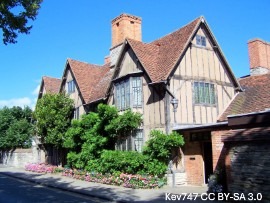
Stratford-upon-Avon home of Shakespeare's daughter is 'At Risk'
Lady Grange’s House repaired on St Kilda
.jpg)
National Trust for Scotland repairs stone cleit with link to famous island resident
Griff Rhys Jones on BBC Radio 4 Today programme
,_Green_Lane,_Derby.jpg)
The Victorian Society’s President unveiled its latest Top Ten Endangered Buildings 2026.
Need a MATE? Book your place now.

IHBC offers free webinars on applying for IHBC accreditation (Full & Associate).
UK Stained Glass Repository finds windows new homes
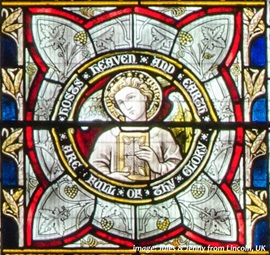
How are stained glass windows are rescued, stored and repurposed?
APPGEBE report sets high aims for quality
'Government must not sacrifice quality in drive to build 1.5m homes'
New measures protect Historic Shipwrecks from heritage crime

Underwater cultural heritage benefits from new HE guidance
How could the City of London skyline look in 6 years' time?

Visualisation shows approved planning applications as completed buildings
National Trust for Scotland calls for VAT cuts
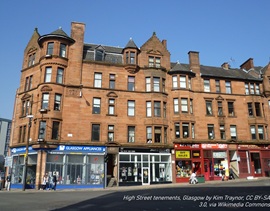
Heritage neglect is encouraged by current policies
IHBC's 'Context' Issue 186 features Industrial Heritage
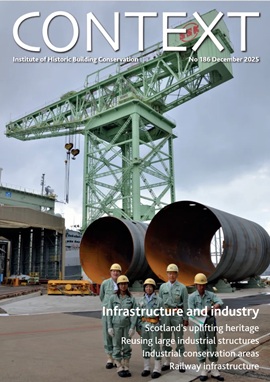
IHBC's members' journal reports on the challenges of conserving infrastructure
Book now for IHBC Annual School 2026
IHBC Annual School is taking place 18-20 June 2026 in Newcastle
RICHeS Research Infrastructure offers ‘Full Access Fund Call’
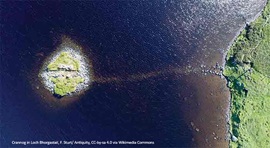
RICHeS offers a ‘Help’ webinar on 11 March
Latest IHBC Issue of Context features Roofing
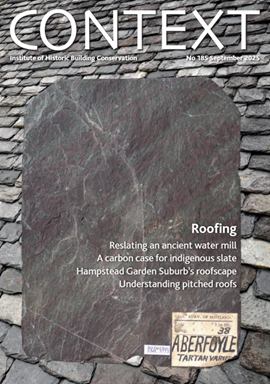
Articles range from slate to pitched roofs, and carbon impact to solar generation to roofscapes
Three reasons not to demolish Edinburgh’s Argyle House

Should 'Edinburgh's ugliest building' be saved?
IHBC’s 2025 Parliamentary Briefing...from Crafts in Crisis to Rubbish Retrofit
IHBC launches research-led ‘5 Commitments to Help Heritage Skills in Conservation’
How RDSAP 10.2 impacts EPC assessments in traditional buildings

Energy performance certificates (EPCs) tell us how energy efficient our buildings are, but the way these certificates are generated has changed.